



Military tensions in the Middle East, fueled by escalating developments involving Iran, the United States, and Israel, have triggered a new wave of volatility across global financial markets.
As seen during previous geopolitical conflicts, stock market fluctuations can be unsettling for some clients who observe their portfolios reacting to these events. As of March 26, 2026, this overview provide factual, historical, and contextual insights to help support clients during this period of uncertainty.
A global energy shock
Global stock markets experienced significant declines in early March 2026, particularly following the near-total closure of the Strait of Hormuz - a corridor through which approximately 20% of the world’s oil passes. This disruption led to:
- A rapid rise in energy prices
- Immediate pressure on international stock markets
➡️ As a result, oil prices climbed above USD 100 per barrel, intensifying the volatility observed across U.S. and global stock indices.
Inflationary pressures and potential economic implications
For financial markets, the main concern is not the conflict itself, but rather how long it may last:
- A prolonged conflict could keep oil prices elevated (between USD 100 - 150 per barrel), increasing inflationary pressures
- Persistently high energy costs could slow economic activity and lead to more restrictive monetary policies, including potential interest rate hikes
| Positive historical outlook
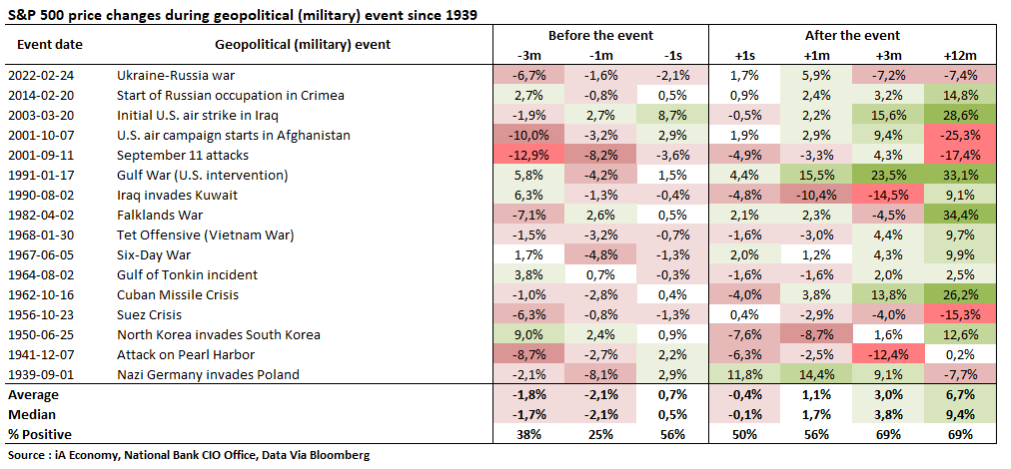
Current market reactions align with patterns observed during past geopolitical events:
These observations may help reassure more anxious clients who may be considering pulling out of the market following short‑term declines. |
The table below illustrates S&P 500 performance during military events dating back to 1939.
Why staying invested is essential
For your clients, the key message remains the same as it was in 2022 during the Ukraine crisis: losses only become real when you exit the market.
Periods of volatility associated with geopolitical conflicts are generally:
- Temporary
- Concentrated in the early days or weeks
- Rarely catastrophic for long-term market performance
A recent example:
In the wake of the energy shock related to the conflict in Ukraine, the S&P 500 rebounded from a -19% decline in 2022 to a +25% gain in 2023, for a cumulative return of roughly +48% over the 2022 - 2025 period2.
These findings serve as an important reminder: staying invested is often more effective than attempting to anticipate market movements. Well‑diversified portfolios typically absorb energy and geopolitical shocks over a period of several months.
To stay informed, we invite you to follow the weekly Economic News presented by Sébastien Mc Mahon, Chief Strategist, Senior Economist and Vice-President, Asset Allocation & Portfolio Manager.
- Source: Bloomberg (données de marché S&P 500), First Trust Portfolios – Wars, Geopolitical Shocks & the Stock Market; Nationwide Investment Management – Patience over panic: geopolitical shocks are no match for long‑term discipline.
- S&P 500 INDEX (^SPX) Historical Data - Yahoo Finance